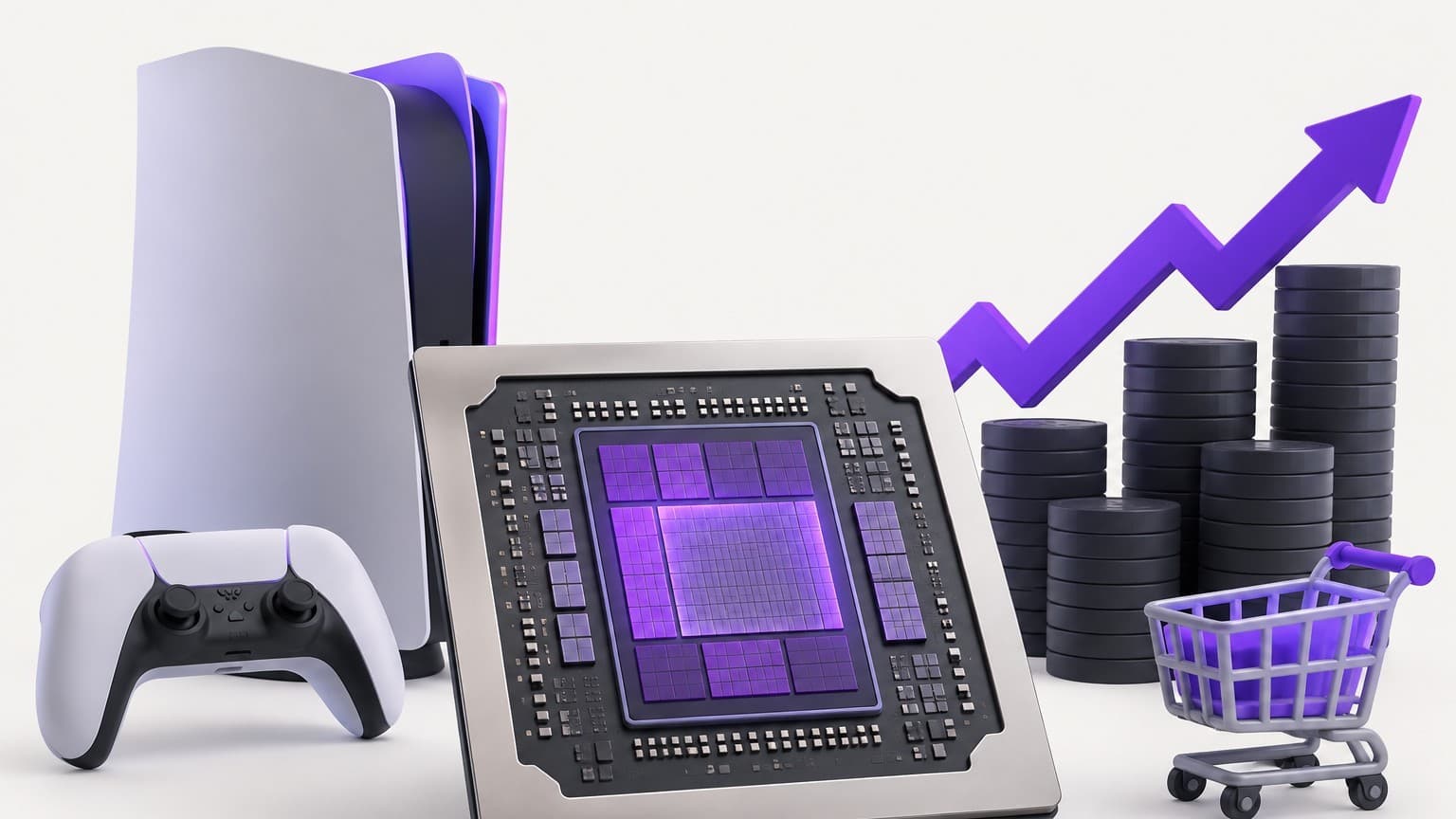
As of late September 2026, Sony and Microsoft have not confirmed the PlayStation 6 or the next-generation Xbox, codenamed Project Helix. But recent leak and analyst reports have put specific figures around graphics performance and price risk. Hardware leaker KeplerL2 claims the consoles' chips are taped out with the PS6's GPU compute at 40 teraflops and Project Helix's at 56 teraflops. Ampere Analysis has warned that $1,000 launch prices could lower combined five-year sales by up to 38 percent.
Earlier, Tech4Gamers reported that Digital Foundry podcast host John Linneman said he had heard from a few sources that Project Helix was originally supposed to include a disc drive to give it an edge over PlayStation 6. He also said the goal is for every Xbox game to run on the new platform, and disc sales are not the main reason. Tech4Gamers said this implied the PS6 would be disc-less, despite earlier reports of a separate disc attachment, and noted the Helix plan predates Asha Sharma taking over Xbox. The outlet described Project Helix as a PC-hybrid, adding that it is rumored to be expensive, and linked the reports to Sony's announcement that it will stop making discs in 2028.
Ampere's pricing scenarios
In the week of August 19, Ampere Analysis released a report on $1,000 next-generation consoles. VGChartz and Instant Gaming covered the findings. Ampere modeled that if Sony and Microsoft launched "conventionally designed, incrementally improved next-generation consoles" at $1,000, the PS6 and Project Helix could sell up to 38 percent fewer units over five years than the PS5 and Xbox Series X|S. VGChartz puts lifetime sales so far at 93.57 million for PS5 and 35.10 million for Xbox Series X|S, and expects 140 million to 160 million combined by the generation's end. If that total materializes, a 38 percent decline would leave the next consoles between 87 million and 99 million units. Ampere also estimated that by 2031, spending on PlayStation and Xbox console games and services would be $3.4 billion, or 12 percent, below what it would be with a $700 launch price. VGChartz wrote that Project Helix has been announced as a hybrid console PC.
Ampere proposed three ways to avoid that price point. Sony and Microsoft could delay the launch beyond late 2028 and extend the current generation; they could keep a 2028 launch but use "heavier hardware subsidies, new monetization models, more aggressive digital content strategies and optimized sales channels"; or they could "substantially innovate on hardware form factor and use cases, placing less emphasis on graphical improvement." LevelUp reported that the third option draws inspiration from Nintendo's Wii. The report's author, Piers Harding-Rolls, said recent price increases for the PS5, Xbox Series X|S and Nintendo Switch 2 make a four-figure launch price more plausible.
Tape-out and TFLOPS claims
More recently, PC Guide and Wccftech reported on NeoGAF posts by hardware leaker KeplerL2. KeplerL2 claimed the AMD chips for both consoles have been taped out, which means the final blueprint phase is complete before production. KeplerL2 placed the PS6's GPU compute at 40 teraflops and Project Helix's at 56 teraflops; on paper that gives the next Xbox 40 percent more GPU compute than the PS6. PC Guide notes for comparison the Xbox Series X is about 12 teraflops, the PS5 is 10.28 teraflops and the PS5 Pro is 16.7 teraflops. PC Guide cautioned that the leaked figures are not proof that Project Helix will run games 40 percent faster. Wccftech added that the numbers align with earlier leaks: the PS6 is rumored to have 52 active compute units and a GPU clock around 3.0 GHz, within a previously reported 2.6-3.0 GHz range. KeplerL2 has previously said Helix has roughly 42 percent more silicon and 20 percent more memory than the PS6.
KeplerL2 also said the tape-out points to a late 2027 release rather than 2028. He and Moore's Law Is Dead have argued that manufacturing contracts with chip production scheduled for Q2 2027 are locked in, and that delaying would cost more than absorbing high RAM prices. Wccftech notes none of this has been confirmed by Sony, Microsoft, or AMD.
Pricing pressure and what is unknown
KeplerL2 put the PS6 bill of materials near $760 in March, with $699 retail still possible; three months later, he reported it had jumped to about $960, a 26 percent increase. Sony's CEO has said publicly that memory costs will remain very high through fiscal 2027. For Project Helix, KeplerL2 placed the bill of materials above $1,000, while Moore's Law Is Dead estimated around $900 at scale, with $999 as an aggressive minimum and $1,200 the most likely figure. Wccftech notes Helix is expected to support open third-party storefronts, which could make it harder for Microsoft to subsidize hardware because it cannot count on software revenue in the traditional way. That leaves four-figure pricing a realistic possibility for both consoles.
What remains known from official sources is thin. Sony's CEO recently said the PS6 release date is still undecided, and Xbox has been seen surveying Xbox Insiders about whether Project Helix should include physical discs and exclusive games. Until Sony or Microsoft confirm, the tape-out, TFLOPS, pricing and launch-window details are leaker and analyst scenarios, not product announcements.

 Photograph: Alexis Lamster/Wikimedia Commons (CC BY 2.0)