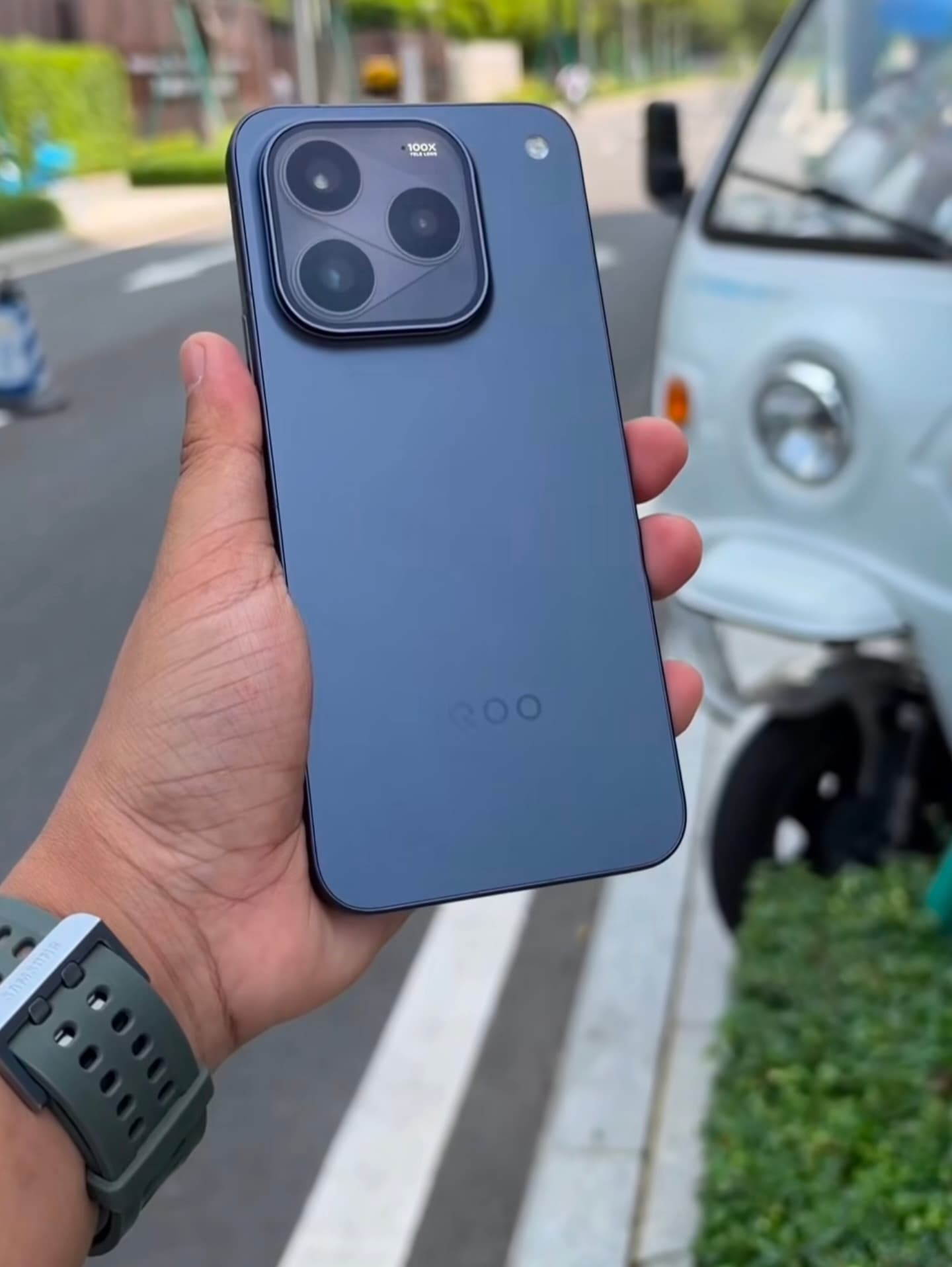
The iQOO 16 went on sale in China on September 29, 2026, MobiDevices and Notebookcheck reported. It is the first Android phone to use Samsung Display's M16 OLED material, according to SammyGuru. iQOO says the panel was developed jointly with Samsung Display and combines M16 material with 2K LEAD 2.0 panel technology, supports refresh rates up to 165Hz and uses an LTPO backplane.
How the display deal came together
Before the September 29 launch, China Daily reported that iQOO was deepening its cooperation with Samsung Display on smartphone screens, moving from a "request-and-deliver" model to jointly defining problems and technical challenges. iQOO vice president Luo Feng said product definition begins 18 to 20 months in advance, and the company did not shrink screen investment even as system-on-chip and memory costs rose. Samsung Display's HJ Lee said, "Technology cooperation cannot be achieved in a short period; it requires a two-to-three-year mid- and long-term roadmap." The company also said the plan includes possible new form factors, such as a foldable gaming handheld concept, over the next three to five years.
What the iQOO 16 brings
The display is a flat 6.85-inch Samsung AMOLED with a resolution of 3,168 by 1,440 pixels and a pixel density of 510 ppi, MobiDevices reported. Its adaptive refresh rate runs from 1Hz to 165Hz, and iQOO says the panel's power consumption is 31 percent lower than a comparable 1.5K screen. Manual brightness reaches 1,100 nits, full-screen brightness 2,800 nits, and local peak brightness 10,000 nits, but SammyGuru notes the 10,000-nit figure applies to a 1 percent on-pixel ratio, not full-screen output. The screen supports HDR10+, Dolby Vision, DC dimming, 3,300Hz PWM dimming and an ultrasonic fingerprint reader.
Inside, iQOO uses Qualcomm's 2nm Snapdragon 8 Elite Extreme Gen 6, with two performance cores up to 5.0GHz and six cores up to 4.0GHz, according to MobiDevices. An iQOO Q4 gaming chip adds frame-rate boosts up to 165fps in supported games, and iQOO claims an AnTuTu score of 5.574 million. The phone has an 8,500mm² vapor chamber, LPDDR5X Ultra RAM and UFS 4.1 storage up to 1TB.
The 8,400mAh silicon-carbon battery is 1,400mAh larger than the iQOO 15's 7,000mAh cell, Notebookcheck reported. Wired charging is rated at 100W, and wireless charging is rated at 40W. The rear camera array has three 50MP sensors: a 1/1.3-inch main camera, a periscope telephoto with 3x optical zoom, and an ultrawide. A 32MP front camera sits on the front.
Pricing in China begins at 5,999 yuan ($894) for 12GB RAM and 256GB storage, and tops out at 8,499 yuan ($1,267) for 16GB RAM and 1TB. The phone went on sale immediately after its September 29 presentation, but iQOO has not announced international release details.
Where it sits among Android rivals
TrueTech reported earlier that the iQOO 16 was expected to join a wave of Snapdragon 8 Elite Extreme Gen 6 phones. Xiaomi's 18 Pro Max launched first on September 23, Honor's Magic9 Pro Max followed on September 28, and the iQOO 16 arrived on September 29; OnePlus, Nubia and Samsung are expected later. Samsung's own Galaxy S27 Ultra and Pro are expected to adopt M16 OLED panels, SammyGuru reported, so iQOO's launch gives it a display-technology head start.
According to TrendForce, worldwide smartphone panel shipments should total about 2.25 billion units in 2026, with AMOLED making up 41 percent, China Daily reported. Chen Yanshun, vice-chairman of the China Optics and Optoelectronics Manufacturers Association, said the display industry's contest is moving from price wars to technology and scenarios.
For now, the iQOO 16 remains a China exclusive, and no European or Indian availability has been confirmed.




 Photograph: Coolcaesar/Wikimedia Commons (CC BY-SA 4.0)